Arya News - Southeast Asia’s largest economy will raise its local content requirement, also locally known as TKDN, for locally produced battery electric four- and two-wheelers to 60 per cent from 40 per cent on Jan. 1, 2027, before raising it to 80 per cent in 2030 under Industry Ministry Regulation No. 6/2022.
JAKARTA – Japanese automakers and suppliers have expressed concern over Indonesia’s local content requirements for electric vehicles as the country prepares to raise the threshold to 60 percent next year as part of a push to deepen its EV industry.
The issue was raised during a meeting between Japanese industry executives and government officials in Nagoya, Japan, on Saturday, where they discussed licensing, financing for small and medium-sized suppliers and certification of local content rules as the country shifts toward EVs, according to the Office of the Coordinating Economy Minister.
“The government welcomes all the feedback and is committed to refining the policies through concrete measures, including addressing ongoing investment barriers,” the office’s secretary, Susiwijono Moegiarso, said in a press release on Sunday.
The meeting brought together executives from PT Toyota Motor Manufacturing Indonesia, PT Denso Indonesia, PT Aisin Indonesia and PT Advics Manufacturing Indonesia.
Indonesia will raise its local content requirement, locally abbreviated as TKDN, for locally produced battery electric four- and two-wheelers to 60 percent from 40 percent on Jan. 1, 2027, before raising it to 80 percent in 2030 under Industry Ministry Regulation No. 6/2022.
Indonesia has long relied on local-content rules to protect domestic industries while using the requirements to encourage manufacturers to build more of their supply chains in the country.
The current 40 percent threshold was designed to help create an EV market and attract initial manufacturing investment while the higher thresholds are meant to push companies to source more of their parts in the domestic market, including locally made battery components.
The integration of EV manufacturers with domestic local supply chains remains limited despite “many companies” having reported that they reached the local content levels mandated by the government, a source at a Japanese automaker told The Jakarta Post.
The issue, the source said, was whether the threshold could drive deeper local manufacturing, technology transfer and supplier development, or weather it could instead be met largely through the assembly of imported components.
If parts production remains weak, the impact could extend beyond individual suppliers to the country’s broader manufacturing base, said the source, on condition of anonymity.
The transition to EVs should take into account the existing components industry rather than having vehicle assembly as a main measure of localization, the source said.
Indonesia’s EV transition has opened the door for new players, with Chinese brands gaining a foothold fast through local assembly without making the heavy upfront investments to build the entire supply chain, often relying on third-party assemblers rather than building their own factories.
Chinese brands have gained ground by offering relatively low-priced EVs, matching local consumers’ spending capacity as well as the government’s push for a speedy electrification of transportation.
Indonesian Automotive Parts and Components Association (GIAMM) secretary-general Rachmat Basuki said local suppliers “have the capability” to make many EV components but still lack capacity in key areas, such as batteries, engines and power-control units.
“Once production reaches sufficient scale, local parts makers will gradually be ready to supply as domestic EV production volumes increase,” said Rachmat, as quoted by Kontan.
PT Hyundai Motor Manufacturing Indonesia chief operating officer Fransiscus Soerjopranoto told the Post on Tuesday that that the South Korean automaker supported the government’s efforts to strengthen the domestic EV ecosystem.
In line with government targets, Hyundai had built out its local supply chain, including battery system and battery pack plants and EV manufacturing facilities, enabling its Kona EV to achieve an 80 percent local-content level, he said.
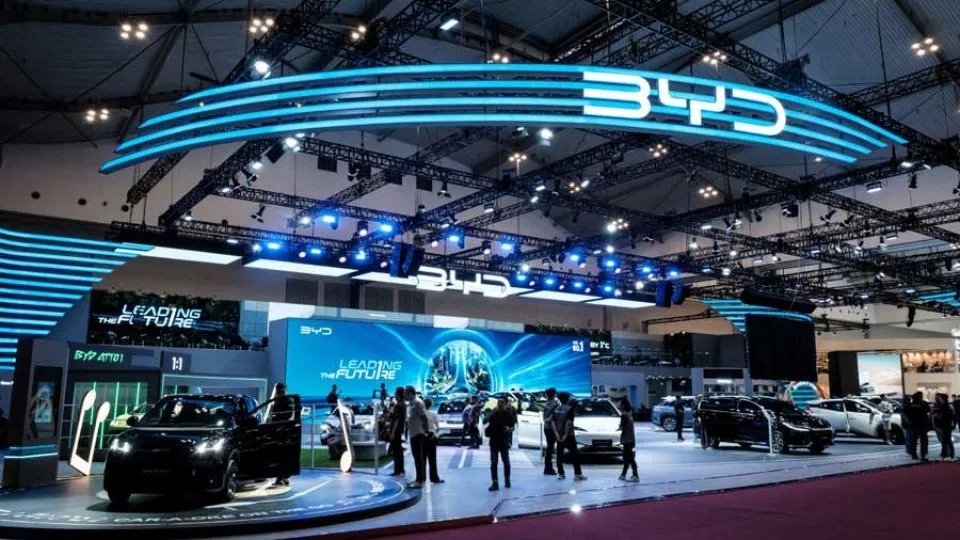
BYD Indonesia president director Eagle Zhao said at the factory’s inauguration in early September that the company was preparing to begin battery assembly and planned to deepen local production at its Subang plant, including stamping, welding and painting.
60 percent local content still on track
The government has so far maintained that it will enforce the 60 percent local content threshold next year, with the higher threshold expected to encourage domestic production of batteries and other auto components and reduce reliance on imports.
Failure to meet the targeted threshold, however, will not prevent an automaker from selling vehicles in Indonesia. Instead, the vehicle would fall outside the government’s Low Carbon Emission Vehicle (LCEV) program and lose access to a series of incentives, said Setia Diarta, director general of metal, machinery, transportation equipment and electronics industries at the Industry Ministry.
EV automakers meeting the threshold will remain eligible for a luxury sales tax waver and an exemption of import duties from countries with free trade agreements in place, including China and South Korea.
The LCEV program included several battery EVs and hybrids under the Low Cost Green Car program launched in 2013.
“The EV industry has grown and developed, with improving demand leading to investment in related component industries. This is the role of TKDN,” Setia Diarta told the Post on Tuesday in an interview.
“The policy does not necessarily make it easy for all investment. Those smaller investments […] have their own struggles,” he said. “At the same time, many companies welcome the local content requirements, because it provides long-term certainty for investment.”
The government would keep the TKDN as part of EV road map through 2030, he emphasized, while continuing to attract manufacturers and component makers to establish domestic production.