Arya News - For Asia’s two leading automakers, Hyundai Motor Group and Toyota, staying competitive in next-generation mobility increasingly depends on how they use China. Yet the two are placing markedly different bets.
SEOUL – China’s rise as an electric vehicle powerhouse is forcing global automakers to rewrite their playbooks. With its speed, tightly integrated supply chains and advanced battery ecosystem, the country is no longer simply the world’s largest EV market — it is where the industry’s next competitive rules are being set.
For Asia’s two leading automakers, Hyundai Motor Group and Toyota, staying competitive in next-generation mobility increasingly depends on how they use China. Yet the two are placing markedly different bets.
Hyundai is seeking a comeback through its joint venture with BAIC, developing localized EVs for Chinese consumers while turning its factories there into export hubs. Toyota is going further: It will build a next-generation Lexus electric SUV at a new wholly owned plant in Shanghai, breaking with its long-standing Japan-first approach.
Toyota bets big on ‘China speed’
Toyota plans to begin producing a next-generation Lexus electric SUV at its new Shanghai plant in late 2027, according to Nikkei. The move would mark the first time the automaker launches a flagship EV outside Japan, breaking with its long-standing Japan-first development model.
Located in Shanghai’s Jinshan district, the facility will be China’s second wholly foreign-owned EV plant after Tesla’s Gigafactory. Built with an investment of 14.6 billion yuan ($2.17 billion), it will have an initial annual capacity of 100,000 vehicles. Production is expected to begin at about 1,000 units a month before expanding to tens of thousands a year after 2028.
The Shanghai-built Lexus will also introduce Toyota’s first use of gigacasting, which replaces multiple body components with large, single-piece aluminum castings. The process can reduce body-part weight by up to 20 percent, extending driving range while simplifying production.
Taking a cue from Chinese EV leaders such as BYD, Toyota reportedly aims to shorten vehicle development from the industry norm of four to five years to just two. More than 95 percent of components — including batteries, motors and software — are expected to be sourced in China.
The push to match “China speed” signals a major shift for the traditionally conservative Japanese automaker: Instead of validating new technologies at home first, Toyota is turning China into a testing ground for advanced manufacturing and vehicle development.
The pivot comes as Toyota faces mounting sales pressure. Its China sales fell 24.3 percent year on year in July to 114,700 units as local EV makers tightened their grip on the market.
“Toyota dominates hybrids, but declining sales in China’s EV-heavy market forced this bold move,” said Lee Ho-geun, a professor of automotive engineering at Daeduk University. “Full localization is essential. China’s tightly integrated EV ecosystem can lower costs and help prevent the delays and cancellations seen in previous EV projects, giving Toyota ample reason to move away from Japan-centered manufacturing.”
Toyota has faced delays and cancellations involving flagship EV projects including the bZ4X and Lexus LF-ZC, exposing the risks of relying heavily on Japanese production.
Lee said that capturing even 5 to 10 percent of China’s vast EV market could generate greater profits than Japan’s domestic market, where annual EV sales remain limited.
Hyundai looks beyond China
Toyota’s China strategy focuses on recovering domestic market share, with exports potentially following. However, the US would likely remain off-limits because of restrictions targeting China-linked supply chains.
Hyundai is pursuing a different model. While Toyota sold about 1.78 million vehicles in China last year, Hyundai’s sales stood at just 128,008 units.
China was once a pillar of Hyundai Motor Group’s global business, generating annual sales of nearly 1.8 million vehicles and putting it among the market’s top three automakers alongside Toyota. Its sales plunged, however, after the 2017 diplomatic dispute over South Korea’s deployment of a US THAAD anti-missile system.
Rather than betting solely on a recovery in Chinese demand, Hyundai is adopting a dual-track strategy: rebuilding its local brand while using Chinese production as a base for exports, Lee said.
At its CEO Investor Day last month, Hyundai Motor President and CEO Jose Munoz reaffirmed the company’s “In China, for China” strategy and its goal of raising annual sales to 500,000 vehicles by 2030. The target includes both domestic sales and exports from China to emerging markets in Latin America, the Middle East and Southeast Asia.
“Hyundai cannot simply wait to see whether its strategic models win over consumers in such a fiercely competitive market,” said Kim Pil-su, a professor of automotive engineering at Daelim University. “It should fully utilize its Chinese production facilities to cut costs and compete directly with Chinese EV makers in emerging markets, where they already have a strong presence.”
To reduce development costs and respond more quickly to local demand, Hyundai is building China-specific vehicles with local supply chains and technology partners including CATL and Momenta, rather than adapting its global models.
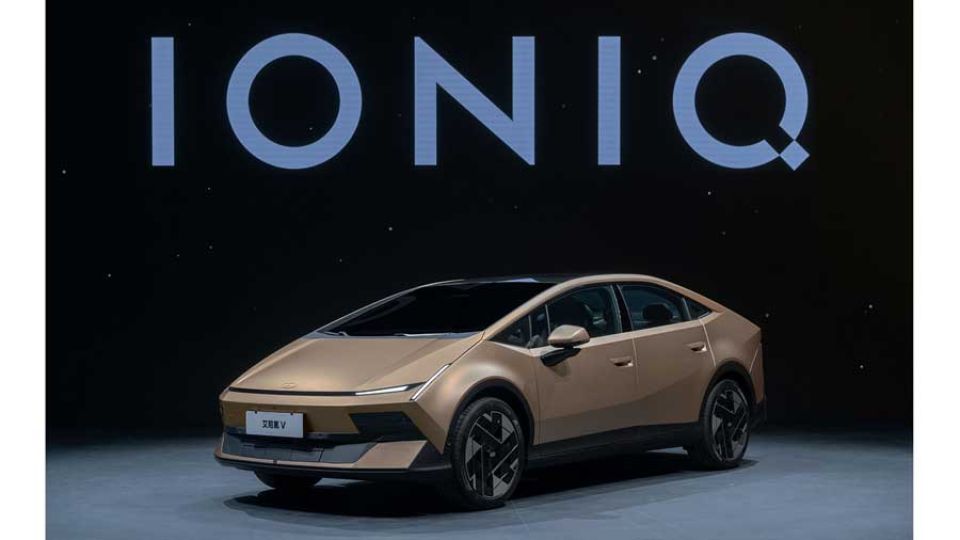
The rollout will begin with the China-exclusive Ioniq V electric sedan, followed in 2027 by B- and C-segment SUVs available with battery-electric and extended-range electric powertrains.
Two strategies, one EV battleground
Experts remain divided over which strategy will give Hyundai or Toyota the stronger position in China’s fast-growing EV market.
Lee said Toyota holds an operational advantage because its wholly owned plant can make decisions and adjust production more quickly than a traditional joint venture.
“Past disagreements between Hyundai and BAIC over supply-chain procurement show how difficult decision-making can be within a joint venture,” Lee said. “That makes it harder for Hyundai to maintain full control over the pace of new-model development.”
Kim, however, pointed to Hyundai’s stronger credentials as an EV brand. Toyota, despite its dominance in hybrids, is still in the early stages of building a broader battery-electric lineup.
“Hyundai’s global EV presence and manufacturing track record could allow it to steadily rebuild its position in China,” Kim said.