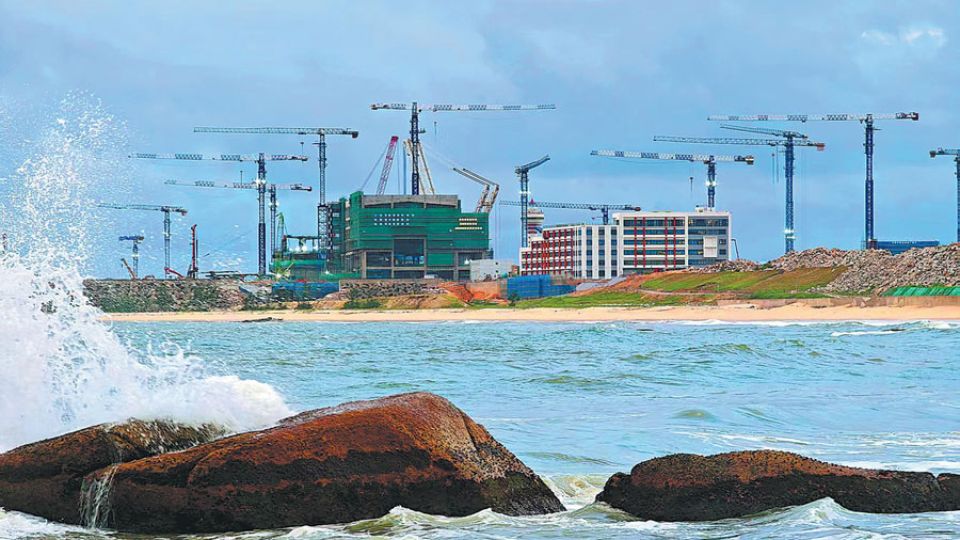
Arya News - Construction work on Guangdong project overseen by digital and human eyes.
LUFENG – Spend more than a few minutes in the workshop at the CGN Lufeng Nuclear Power Project in Guangdong province, and it is hard to miss the robot dog checking fire safety.
At first, it may look almost casual, moving across the concrete floor in an unhurried trot. But once a welding torch flares up, its sensors tell another story. The machine can move close to a hot-work scene, take photos and check whether the operation is being carried out properly — a quiet mechanical watchdog in the welding bay.
Its patrol route can be planned according to the upcoming work schedule. Driven by 5G, it can inspect a workshop or a wider plant area on its own, using heat and optical sensing to identify hot-work activities. When its battery runs low, it returns to its charging station by itself.
The robot dog is one small part of a broader push at the Lufeng nuclear project to bring artificial intelligence, robotics and digital management tools into nuclear power construction. The technologies are being used not as display pieces, but to help make a large and busy construction site safer, more efficient and easier to manage.
The project is China General Nuclear Power Corporation’s ninth nuclear power project and the first major nuclear energy project in eastern Guangdong. It is planned to have six million-kilowatt-class pressurized water reactor units.
When all six units are in operation, they are expected to generate some 52 billion kilowatt-hours of electricity annually, and reduce carbon dioxide emissions by about 48.05 million metric tons a year, according to the project’s plans.
Scale is one part of the challenge. Units 5 and 6, both using Hualong One technology, are under construction together with Units 1 and 2, which use the CAP1000 reactor design. These units are scheduled to be put into operation by 2030.
Xu Kai, an engineer with the security and protection department at CGN Lufeng Nuclear Power Co, said the construction site has about 30,000 authorized workers and more than 2,000 work activities of different risk levels on a normal construction day.
To keep such a complex site “visible, controllable and traceable”, Lufeng has built an integrated command center, Xu said. Construction progress, worker qualification data, equipment status and environmental monitoring information are brought together on large screens, allowing managers to follow changing conditions in real time.
Each worker is linked to a digital file that includes pre-job training records, qualification certificates and health examination information. Access-control gates automatically check whether a worker has the required authorization before allowing entry into a work area.
The center can also display the real-time number of people entering or leaving each gate and connect the information with nearby cameras.
For high-risk operations, the site is divided into risk zones on a three-dimensional model. Command center staff can click on a high-risk work item and immediately view cameras in the surrounding area, Xu said. Monitoring systems collect data on slope displacement, nuclear island foundation pit water levels, and environmental parameters around the clock, with abnormal readings triggering warnings.
AI cameras have been introduced in key areas to identify and capture potential hazards, including workers not wearing personal protective equipment properly, entry into dangerous areas, smoking and signs of fire, Xu said.
He said the system enables real-time early warning and rapid response, significantly reducing the time from hazard identification to resolution.
The same approach is being extended from safety monitoring to construction quality. According to CGN Lufeng Nuclear Power Co, the company has developed 33 digital applications to support intelligent monitoring, early warning, response and evaluation.
An AI-based system for identifying embedded parts can compare scanned site data with drawings and design standards, checking the number, position, and elevation of embedded parts, said Cheng Lei, deputy manager of the engineering department at CGN Lufeng Nuclear Power Co.
In this application, the technology improved checking efficiency by 75 percent and reached 100 percent identification accuracy, while reducing the need for workers to climb for measurements.
In electrical commissioning, AI is also being used as an auxiliary tool. Wang Zhichao, a senior supervisor for plant power distribution commissioning, said workers face a large number of precondition checks every day. Photos can be uploaded for AI-assisted review to see whether conditions are met and whether safety risks exist.
However, the AI result is not the final decision, Wang said, adding that human review remains necessary.
His point is echoed across the site. Intelligent tools are being used to reduce blind spots and repetitive work, not to remove professional judgment from nuclear construction.
That principle is also visible on the fabrication side, where automation is changing welding work. Lei Yao, engineering deputy manager at China Nuclear Industry 23 Construction Co’s Lufeng project, said the nuclear island involves about 200,000 weld joints, of which about 160,000 are small-pipe welds.
Lei said the small-pipe welding workshop has introduced standardized fixtures, QR-code marking, digital traceability for materials, and robotic safety patrols. The fire-watch robot dog can help identify unsafe behavior and hidden risks, such as fire, heavy smoke, or workers at height who have not attached safety harnesses, he said.
The workshop’s small-pipe autogenous welding technology is a key example. Compared with manual welding, the automatic process reduces dependence on highly experienced welders, improves stability and shortens welding time.
Lei said the workshop had some 60 workers when it started, including about 12 welders. After the automatic welding technology was put into use, the total number of workshop workers fell to around 30 to 35, with only about four welders needed to operate the autogenous welding facility.
A skilled manual welder may need three to five years of training to achieve a stable qualification rate for nuclear work, Lei said. With the automatic system, workers shift from direct welding to operating equipment and monitoring the process.
He said the qualification rate for the automated small-pipe welding process has stayed above 99 percent in long-term use, compared with about 97 percent for manual welding in the cited workshop experience.
Complementing these shop-floor advances, Jiang Jiang, deputy manager of the digital intelligence documentation department at CGN Lufeng Nuclear Power Co, pointed to broader digital initiatives.
“The company is building a 3D digital twin model of the entire plant site,” he said. “It synchronizes real-time construction progress and environmental data, enabling visual, refined and intelligent management and control.”
The company is also developing a full-life-cycle digital document management system that electronically archives and makes all engineering documents, equipment ledgers, safety records and monitoring data traceable in order to improve management efficiency.
“This comprehensive intelligent upgrade has effectively achieved our core goals: fewer personnel, higher efficiency, better safety, and better quality,” Jiang said.